
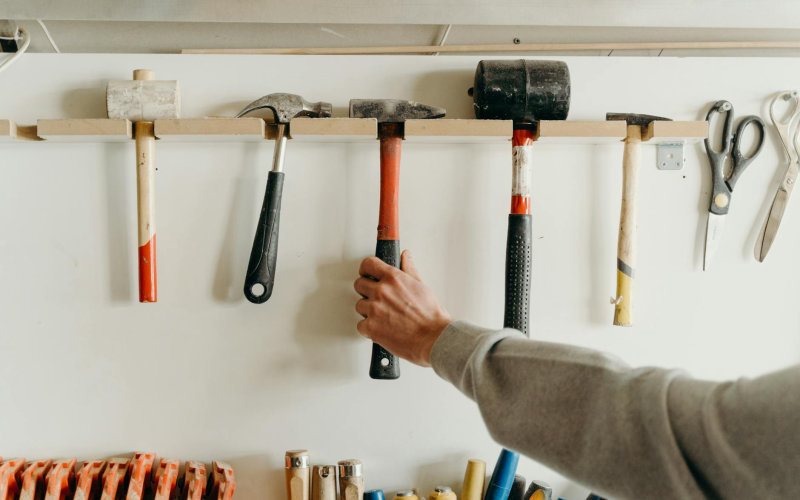

Most people walk into their garage, look at their drill and their hammer, and think they’re ready. They’re not. The difference between a DIYer who gets mediocre results and one who produces work that genuinely stuns people isn’t talent, and it isn’t expensive power tools. It’s the specific hand tools sitting in between — the ones most guides never mention because they’re not flashy enough to sell magazine covers.
I’ve been building, fixing, and renovating for over a decade. And I’ll tell you something most tool lists won’t: the tools that changed my results most dramatically cost less than $40 each. What follows isn’t a list of basics you already own. These are the tools that separate good from extraordinary.
1. A Marking Knife Instead of a Pencil
Stop marking your cuts with a pencil. Seriously, stop. A marking knife — something like the Veritas Mk.II, which runs about $38 — severs wood fibers before your saw does, giving you a crisp, tear-free line that a 2B pencil simply cannot replicate.
The first time I switched to a marking knife on a cabinet project back in 2022, my joint accuracy improved immediately. Not gradually. Immediately. When your layout line is a physical groove in the wood rather than a fuzzy graphite smear, your chisel and saw have something real to register against. That’s not a small thing. That’s the foundation of precision.
2. A Japanese Pull Saw
Your standard Western push saw works against you on thin stock and delicate cuts. A Japanese pull saw. brands like Suizan or Gyokucho make excellent ones for under $30, cuts on the pull stroke, which keeps the blade under tension and prevents the flex that causes wandering cuts and blowout.
And the teeth are extraordinary. We’re talking 17 to 22 teeth per inch on a crosscut blade, versus the 10 to 12 you get on most Western saws. The result is a smoother, finer kerf that demands almost no cleanup. If you do any furniture work, trim carpentry, or dovetail joinery, this tool will make you feel like you suddenly got better. You didn’t get better. you finally got the right tool.
3. A Card Scraper
This one baffles me. Woodworkers have used card scrapers for centuries, and yet most modern DIYers have never held one. A card scraper is a thin rectangle of hardened steel, sometimes just $8 to $12 for a set of three. that, when properly burnished, removes paper-thin shavings from wood surfaces with a control that sandpaper can never match.
Sandpaper rounds over edges. Sandpaper clogs grain. A card scraper does neither. On figured maple or highly interlocked grain that would tear out under a plane, a scraper glides clean. I spent an entire Saturday afternoon in 2023 trying to sand out tearout on a walnut tabletop before a friend handed me a scraper and watched me solve the problem in twelve minutes. That moment changed how I work.
4. A Combination Square Worth Trusting
Not all combination squares are equal, and this is the uncomfortable truth most beginners discover too late. The $9 version from a big-box store is almost certainly not square. Guaranteed inaccuracy, right there in your toolbox, corrupting every measurement you make.
A Starrett 12-inch combination square costs around $85. That sounds steep until you realize every line you draw, every cut you set up, every right angle you verify is now actually correct. Accuracy compounds. One trusted measurement leads to the next, and suddenly your projects stop having that slightly-off quality that’s hard to name but impossible to ignore. Buy it once. It outlasts you.
5. A Sliding Bevel Gauge
Most DIYers can handle right angles. But the moment a project throws a 22.5-degree bevel, a raked roof cut, or an angled frame joint at them, they freeze. A sliding bevel gauge, also called a bevel square. captures any angle you need and transfers it exactly to your workpiece.
Set it from a protractor. Set it directly from an existing piece. Set it from your miter saw’s indicator. However you lock it in, it holds. The Shinwa bevel gauge runs about $22 and is ridiculously accurate for the price. Once you own one, you stop fearing non-standard angles. And that opens up an entirely new class of projects you previously avoided.
6. A Rubber Mallet (A Proper One, Not That Beaten-Up Old Thing)
Yes, you probably own a rubber mallet. But is it a quality dead-blow mallet with shot-filled cavities that eliminate rebound? Probably not. A dead-blow mallet, something like the Estwing 32-oz dead-blow, available for around $25. transfers energy directly into the workpiece instead of bouncing back into your wrist.
This matters enormously when assembling cabinetry, seating tenons, or adjusting a door frame that needs to move an eighth of an inch without damage. A standard rubber mallet fights you. A dead-blow mallet cooperates. The difference feels subtle until the moment it doesn’t, which is exactly when you’re trying to hold a glue-up together with three minutes of open time left.
7. A Burnishing Tool for Your Scrapers
So you bought that card scraper from number three on this list. Now what? A flat piece of steel won’t cut anything until you create a tiny hook on its edge, called a burr, using a burnishing rod. Without this tool, your scraper is useless.
A good burnishing rod. the Veritas burnisher costs around $27, hardens and turns the scraper edge in minutes. It sounds technical. It takes about four minutes to learn. And once you can maintain your own scraper edges, you’ve eliminated the sandpaper dependency that’s been quietly ruining your finishes for years. This is the tool that completes the tool.
The Honest Truth About Building a Better Shop
Here’s what I believe with everything I have: your results are a direct reflection of your standards. Not your budget. Your standards. Every one of these seven tools costs under $90. Together, they run you maybe $310 total. And they will elevate your work more meaningfully than a $600 router table will.
The serious DIYer who owns these tools doesn’t just build things. they build things that last, things that fit, things that other people look at and ask, “Who made this?” Start with the marking knife and the combination square. Get those two right, and the rest of your work starts clicking into place. Precision is a habit. And habits, built on the right tools, change everything.
Photo by cottonbro studio on Pexels

