
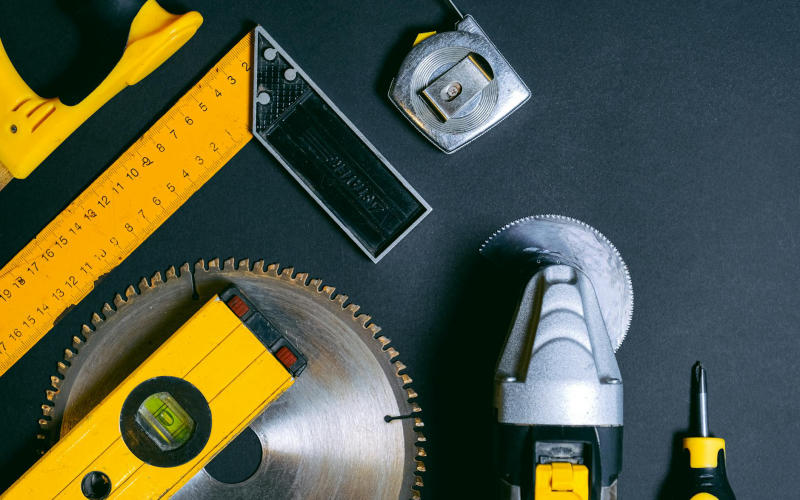

Most people think they’re ready for summer projects. They’ve got a hammer, a cordless drill still in the charcoal-gray case from three Christmases ago, and enough ambition to redesign their entire backyard. Then the project starts — and somewhere around hour two, they’re driving to Home Depot for the third time in a single afternoon because they don’t have the one tool that would make everything click.
That’s not a motivation problem. It’s a preparation problem. And the difference between a homeowner who finishes summer projects with pride and one who leaves half-finished deck boards sticking up like a hazard is almost never skill. It’s tools. Specifically, the forgotten ones. The hand tools that every expert keeps in their kit but that almost no beginner’s checklist bothers to mention.
I’ve spent summers rebuilding fences, rehanging doors that humidity had warped beyond recognition, and caulking window frames in 88-degree heat. I know which tools sit untouched and which ones earn their place every single weekend from June through August. These are the ones that actually matter.
A Quality Pull Saw Instead of That Cheap Hardware Store Hack Saw
Most homeowners own a handsaw that costs less than a fast-food lunch. You can feel the difference the moment you grab a real Japanese-style pull saw — the Suizan 9.5-inch double-edge model runs about $28 and cuts on the pull stroke, which means you’re using muscle with actual mechanical advantage instead of fighting the wood.
Pull saws slice through 2x4s clean. No splintering, no burning, no cursing. For summer projects involving trim work, cutting deck boards to fit, or trimming door bottoms that are dragging on new flooring, this tool changes everything.
A Card Scraper: The Tool Most Guides Completely Ignore
Nobody talks about card scrapers. That’s a mistake.
A card scraper is a flat piece of hardened steel, roughly the size of a playing card, that shaves thin curls of wood rather than sanding them away. For refinishing a wood deck, smoothing a stair tread, or cleaning up dried wood filler before painting, it produces results that sandpaper genuinely cannot match — and it does it in a quarter of the time. A decent set from Bahco runs about $12. It’s one of the highest return-on-investment tools you’ll ever own.
A Contour Gauge for Fitting Trim Around Complicated Shapes
Here’s the situation: you’re installing baseboard trim around a door casing, or fitting a piece of decking around a post. The shape isn’t a simple angle. You can spend 45 minutes measuring, transferring, guessing, cutting wrong, measuring again. or you press a contour gauge against the shape for four seconds and trace it directly onto your material.
These are roughly $15 at any hardware store. The General Tools model has been around since the early 1990s and still works better than digital alternatives that cost five times as much. Buy the widest one you can find; 10 inches covers almost everything you’ll encounter in a typical summer project load.
A Good Marking Gauge, Not Just a Pencil
Pencils lie. When you draw a line freehand along a board, what feels straight never quite is, and that slight wobble compounds over eight feet of baseboard or a run of fence pickets. A marking gauge, a small tool with a calibrated fence and a sharp pin or blade. scribes a perfectly parallel line every time.
So your fence posts end up level. Your deck boards gap evenly. Your trim looks like you hired someone. The WoodRiver adjustable marking gauge sells for around $22 and it’s worth every cent. Use it before you make any cut that runs parallel to an edge.
A Nail Set: Simple, $5, Constantly Forgotten
Every homeowner who has ever hammered a finishing nail and left a round dent in their trim knows exactly what a nail set would have prevented. It’s a small steel punch that seats the nail head just below the wood surface without touching the surrounding material. You fill the hole with wood filler, sand it, paint it, and suddenly your work looks professional.
A 3-piece set at Ace Hardware costs $5. I cannot count the times I’ve watched someone skip this step and spend twice as long trying to fix the resulting damage.
A Caulking Finishing Tool That Isn’t Your Finger
Your finger is not a caulking tool. I know we all use it. I’ve used it. But the results are uneven, you burn through caulk faster than necessary, and the joint always looks slightly off. A proper caulking finishing tool. the Anvil brand set at Home Depot runs about $8, creates a consistent concave bead that actually sheds water and looks intentional.
For summer projects involving exterior caulking around windows, door frames, or where siding meets trim, this matters enormously. A bad caulk joint lets moisture in over winter and turns a cosmetic issue into a structural one.
A Quality Level That’s Actually Flat
Not every level is flat. That sounds absurd, but cheap levels are often inaccurate straight out of the packaging. sometimes by as much as a quarter bubble. If you’re hanging a gate, building a raised garden bed frame, or installing deck hardware, a bad level guarantees crooked work.
The Empire 48-inch magnetic box beam level costs about $35 and has been a standard recommendation from finish carpenters for years because they actually test flat. Verify yours before you trust it: hold it against a wall, mark the bubble position, flip it 180 degrees, and check if the bubble reads the same. If it doesn’t, throw the level away. Seriously.
A Flexible Putty Knife in the 3-Inch Size
Most homeowners own a stiff putty knife. It’s the wrong tool for half of what they use it for. A flexible 3-inch blade, like the Hyde Tools flexible stainless model, lets you feather wood filler or exterior spackling compound smoothly over a surface rather than dragging and tearing it. The difference between a patched surface that blends and one that looks patched is almost entirely this flexibility.
Where to Start
If I had to rebuild my hand tool kit from scratch before this summer, I’d buy the pull saw, the marking gauge, and the level first. Those three alone will improve the quality of almost everything you build or repair between now and September.
Here’s the truth most tool guides won’t tell you: the skill ceiling for hand tools is not that high. You don’t need years of practice. You need the right tool, sharpened or properly calibrated, used consistently. That’s what separates the homeowner who finishes the project from the one who almost did. You have the ambition. Now match it with the right equipment.
Photo by Anna Shvets on Pexels

