
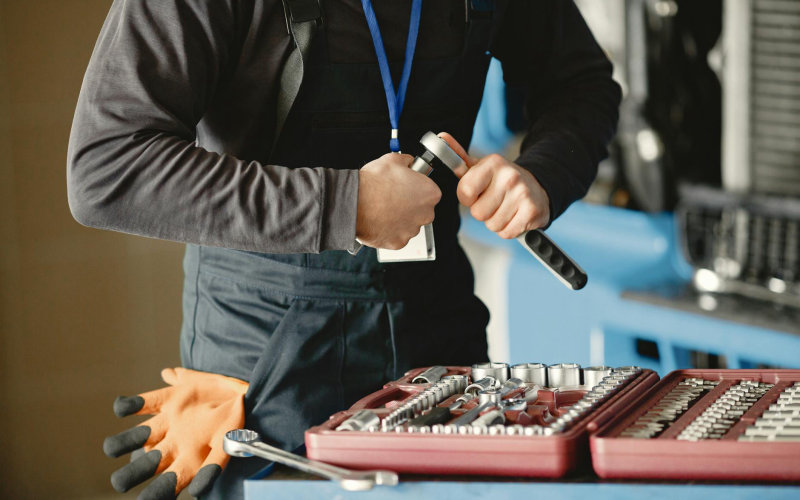

You think a torque wrench is for mechanics. You think it lives in a professional shop, bolted to some guy’s toolbox between a compression tester and a set of metric sockets. You think it has nothing to do with your life.
That belief is costing you. Right now, somewhere in your home, something is either dangerously under-tightened or slowly being destroyed because it was over-tightened. A deck railing. A bicycle stem. A toilet flange bolt cracked at the base. These aren’t car problems. These are your problems.
I’ve been in enough garages and workshops over the past twelve years to tell you this with complete conviction: the torque wrench is one of the most underutilized tools a homeowner can own, and the people who discover it late always say the same thing — “I wish I’d started using this years ago.”
The Hidden Cost of Guessing
Here’s what most people don’t understand about tightening bolts. Tighter does not mean better. Tighter can mean cracked porcelain. Tighter can mean a snapped stud inside your deck ledger board, which you won’t discover until a family member leans on the railing in 2028 and something gives way.
Manufacturers spend serious money engineering the exact amount of clamping force a fastener needs. That number exists for a reason. When you ignore it and go by feel, you’re gambling with structural integrity. And your feel? It gets worse over the years, not better. Fatigue, age, and confidence all conspire to make you overtighten without even knowing it.
Bicycle Maintenance Alone Justifies the Purchase
Let me be direct about this. If you own even one modern bicycle — a carbon fiber road bike, an aluminum mountain bike, a quality commuter. you need a torque wrench. Full stop.
Carbon fiber components have torque specs measured in Newton-meters so low that most people blow right past them with a standard Allen key. Handlebar stems are typically spec’d at 5 Nm. Seatpost clamps often sit at 4 Nm. That’s not much. A confident twist with a long hex key will exceed those numbers easily, and cracked carbon doesn’t give you a warning. It just fails, usually when you’re in motion.
I made this mistake once with a friend’s bike in 2019, overtightened a stem faceplate, cracked a carbon steerer, cost him $340 to replace the fork. A torque wrench costs $35 to $80 for a solid click-style model like the Tekton 24335. The math isn’t complicated.
Deck and Structural Hardware Done Right
Every spring, homeowners across North America pull out their drills and start driving lag screws into deck joists and ledger boards without a second thought. Some are too loose. Most are too tight. Very few are correct.
Structural hardware like Simpson Strong-Tie joist hangers and ledger screws have torque specifications published right in their installation guides. A 1/2-inch lag screw into a ledger board typically needs to be torqued to between 30 and 60 foot-pounds depending on wood species and depth. Without a torque wrench, you’re guessing at structural connections that hold weight-bearing loads.
And it’s not just the big stuff. Deck railing post bolts, carriage bolts through composite decking, even the hardware that holds your pergola together. all of it has a spec, and all of it matters when the goal is something staying put for the next fifteen years.
Furniture Assembly That Actually Lasts
IKEA and other flat-pack manufacturers include torque-relevant instructions. You probably ignore them. So did I, for a long time.
But think about the furniture that fails first: chairs with wobbly legs, bed frames that creak and shift, bookshelves that slowly rack to one side. A significant portion of that failure comes from inconsistent fastener tension. Some bolts hand-tight, some gorilla-tight, the whole assembly stressed unevenly.
A beam-style torque wrench, the simple kind that costs around $25. lets you set every bolt in a bookcase to the same specification. The result is furniture that behaves like it was assembled in a factory, not on a Sunday afternoon with one eye on the game.
Plumbing Fixtures and the Cracked-Porcelain Problem
This one hits close to home. Literally. Toilet seat bolts, closet flange bolts, pedestal sink mounting hardware, these all thread into or against porcelain, which does not forgive overtightening.
A cracked toilet base from an overtightened flange bolt will cost you $200 to $800 in replacement and labor. The torque spec on those bolts? Usually around 5 to 8 foot-pounds. That’s almost nothing. You can’t feel that with your hands. You need a tool.
Same principle applies to faucet mounting hardware under a sink, to the compression fittings on supply lines, and to the packing nuts on shutoff valves. Plumbing connections live right at the intersection of “must be tight enough to seal” and “cannot be tight enough to crack or strip.” A torque wrench lets you find that line every time.
Gas Appliance Fittings: No Room for Error
Now we’re talking about something where the stakes are genuinely high. Gas line fittings. connecting a gas dryer, repositioning a stove, installing an outdoor grill quick-disconnect, have torque specs that exist not for performance reasons but for safety reasons.
Under-tightened means a slow leak. Over-tightened means damaged threads that won’t hold a seal long-term. Either scenario is dangerous. Most homeowners either torque by feel or use a regular wrench and stop when it “seems right.” That is not a strategy worthy of your family.
A quality torque wrench. I’d recommend the CDI Torque 1002MRMH for household work, gives you documented, repeatable precision. The kind that lets you actually verify what you’ve done.
What Most Guides Get Wrong
Every tool guide will tell you a torque wrench is for cars. Change your oil, check your lug nuts, move on. And yes, it does those things beautifully. But that framing undersells the tool to the one group that might need it most: homeowners who never work on cars but who live in houses full of fasteners that matter.
The real value of owning a torque wrench isn’t the precision on any single project. It’s the shift in how you think about assembly. You stop trusting your wrist and start trusting a specification. You stop guessing and start verifying. That shift. from guesswork to certainty, is what separates the homeowner who replaces cracked fixtures from the one who never has to.
Buy the tool. Start with a 3/8-inch drive click-type wrench with a range of 10 to 80 foot-pounds. It’ll cover 90 percent of your around-the-house needs. And the first time you hear that satisfying click on a critical bolt and know, definitively, that it’s right. you’ll understand exactly what I mean.
FAQ
What size torque wrench is best for general home use?
A 3/8-inch drive click-style wrench with a range of roughly 10 to 80 foot-pounds handles most household applications. For very low-torque work like bicycles or electronics, add an in-lb (inch-pound) wrench rated from about 20 to 200 in-lb.
Can I use a torque wrench on IKEA furniture bolts?
Absolutely. A beam-style torque wrench works well for flat-pack furniture since those bolts are typically tightened to modest specs. Check the assembly guide for any published torque values, or use a consistent moderate spec like 8 to 12 Nm across similar hardware.
How often should I calibrate my torque wrench?
Most manufacturers recommend recalibration every 12 months or every 5,000 cycles, whichever comes first. For typical homeowner use, a few projects per year. annual calibration is more than sufficient. Store it at the lowest torque setting to preserve the spring mechanism.
Photo by Gustavo Fring on Pexels

