

I’ve been poking around garages and hardware stores since roughly 2012. And in all that time, one thing keeps proving itself true: the tools that genuinely change how you work are almost never the ones with the biggest marketing budgets. They’re the odd little gadgets you nearly scroll past on Amazon at 11pm, half asleep, wondering if they’re gimmicks.
So this year I went deep. Tested things, read reviews, dug through home improvement forums, and put together what I honestly believe are the best DIY tools that will make your projects easier to complete in 2026. Not the flashy power-tool stuff everyone already knows about. The clever, practical things that fix the problems you actually run into on a Tuesday afternoon when something’s already gone sideways.
Some of these you’ll recognize. A few might catch you off guard. Every single one earns its spot in a real toolbox.
The Pivoting Bit Holder You Didn’t Know You Needed
Picture this. You’re driving screws into a tight corner behind a cabinet, your drill won’t fit at the right angle, and you’re essentially just mashing the bit against the screw head and hoping. Sound about right?
The DeWalt Pivoting Impact Driver Bit Holder fixes exactly that. It pivots up to 20 degrees and locks solid, letting you drive fasteners at angles that would otherwise force you to either give up or wrestle with a hand screwdriver for twenty minutes. Works with any impact driver. Costs around $15.
But the reason I’m leading with this one is simple — it’s the kind of tool you buy once and then can’t believe you tolerated life without.
A Measuring Tool That Actually Keeps Up With You
Miter saws are genuinely great. Getting consistent, accurate cuts out of them, though? That can burn through a stupid amount of time if your setup keeps drifting or you’re manually measuring every single piece.
The Reekon M1 Caliber clips right onto your saw fence and delivers instant readouts for straight cuts, miters, and bevels — in fractions or decimals, whichever way your brain naturally works. It’s not cheap (somewhere between $149 and $179), but if you’re doing serious trim work or building furniture, those time savings compound fast. Estimates suggest it can reduce measurement-related errors by roughly 60% on repetitive cuts.
So if accuracy matters to your project — and it probably does — this one’s worth the splurge.
Stop Losing Screws Forever
This sounds almost too mundane to bother mentioning. It isn’t.
The RAK Magnetic Wristband packs 10 embedded magnets into a breathable, adjustable band. Strap it on and your screws, drill bits, washers, and Allen wrenches just… stay close to you. Up a ladder? Screws on your wrist. Working overhead? Same deal, no fumbling.
I know people who laughed at this thing. Then bought three of them. It runs about $14 to $18 on Amazon and carries thousands of 4.5-star-plus reviews as of early 2025. Cheap, genuinely useful, solves a real daily annoyance.
See Inside Walls and Pipes Without Calling Anyone
This one feels faintly sci-fi, but it’s completely real. Endoscope cameras — tiny cameras on a flexible cable that plug into your phone — have gotten legitimately good over the last couple of years.
The Matrixcamp Endoscope (under $30 most days) is only 7.9 millimeters wide, stretches up to 16.4 feet, shoots in 1920p HD, carries eight adjustable LEDs, and is fully waterproof. Snake it into HVAC vents, drain pipes, inside walls before you cut into them — anywhere you’d normally be working completely blind.
Before you call a plumber to diagnose a slow drain, stick one of these in there first. Might save you a $200 service call. That’s not an exaggeration. That’s just Tuesday.
Clamps That Adapt Instead of You Buying 40 Different Sizes
Every woodworker will tell you the same thing: you never have enough clamps, and they’re never the right size. Both statements are true. But there’s a smarter approach than just buying more.
Stanley makes a clamp system that bolts directly onto standard 2×4 lumber. Cut the board to whatever length your project calls for, attach the clamps, and you’ve suddenly got a custom-sized clamp without purchasing a new one. It’s such a sensible idea that I’m honestly a little irritated nobody showed it to me sooner.
And the non-marring pads mean you’re not leaving divots in your workpiece. Small thing. Matters a lot when you’ve spent three weekends on a single cabinet.
A Contour Gauge That Makes Flooring Cuts Bearable
If you’ve ever installed laminate or vinyl plank flooring around a door frame, you know the specific misery of getting that cut wrong and ending up with a gap you just have to stare at forever. The Saker Contour Gauge is your fix.
Push it against any irregular shape, lock the teeth, and you’ve got an exact profile to trace onto your material. Door casings, pipes, baseboards, anything with an awkward outline — it handles all of it. Made from ABS plastic, so it won’t warp or rust sitting in a damp garage between uses.
Not glamorous. But it’ll save you from re-cutting a $4 plank six times because you were eyeballing the measurement and hoping.
Ladder Safety Gear That’s Actually Practical
Falls from ladders send roughly 164,000 Americans to emergency rooms every single year, according to CDC data from 2023. Most of those falls happen on residential ladders. And most of them are preventable.
The Elesude Ladder Stabilizer is a multi-function bracket system that levels your ladder on uneven or sloped ground, gives you a safe working platform on stairs (that specific feature is huge — stair ladder setups are notoriously sketchy), and functions as a standoff when you need clearance from the wall. It supports up to 500 pounds and has rubber grip feet so it’s not sliding out from under you mid-job.
Here’s what I’d actually say about this one: your ladder setup is not the place to cut corners. Buy the stabilizer. Use it every time. Don’t be a statistic.
Bottom Line
Here’s the thing nobody really talks about. Most DIY injuries and mistakes don’t happen because someone grabbed the wrong power tool — they happen in the in-between moments. Reaching awkwardly for a dropped screw on a ladder. Guessing at a cut because measuring felt too slow. Skipping the stabilizer because the job is “just quick.” The tools on this list are mostly cheap, mostly unglamorous, and almost all of them target those exact in-between moments.
That’s actually the whole game. Not the table saw. Not the fancy drill. The $15 bit holder that keeps you from wrenching your shoulder in a crawl space at 7pm. Build your toolkit around friction points — the specific moments where things slow down or turn dangerous — and you’ll work faster, safer, and with considerably less swearing.
Frequently Asked Questions
What’s the most useful budget DIY tool for 2026?
The RAK Magnetic Wristband at around $15 is hard to top for sheer price-to-usefulness ratio. It solves a genuine daily frustration and once you own one, you’ll reach for it constantly.
Are endoscope cameras worth buying for home use?
Yes, genuinely. If you’re doing any work involving pipes, walls, or HVAC, seeing what you’re actually dealing with before you start cutting or calling professionals can save you real money. The good ones are under $30 now.
Do I need special tools for laminate flooring installation?
A contour gauge like the Saker makes the trickiest cuts around door frames and irregular shapes dramatically more manageable. Pair it with a decent jigsaw and you can handle most obstacle cuts yourself without professional help.
How do I make my ladder setup safer without spending a lot?
A quality ladder stabilizer (the Elesude model runs about $40 to $60) handles the majority of real-world safety problems — uneven ground, stair setups, roof work. It’s one of those purchases that only feels expensive until something goes wrong.
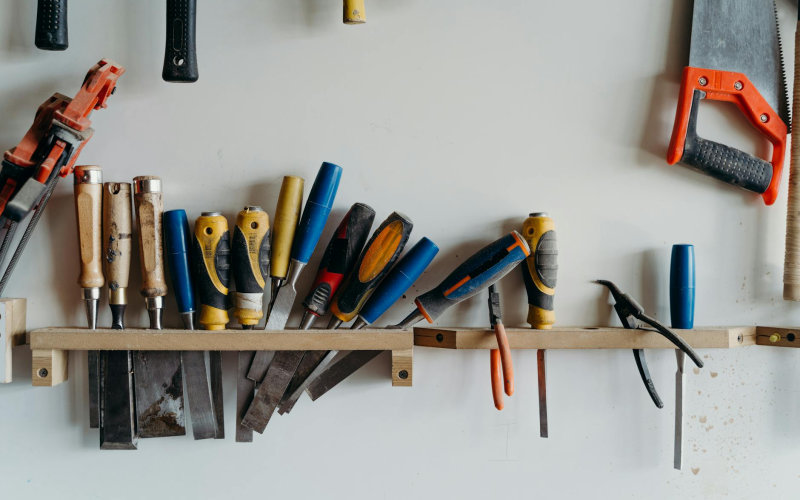
Photo by cottonbro studio on Pexels

